Ottawa's housing market gave sellers a little breathing room in October 2026. Sales picked up from September and fewer new listings hit the market, but prices are still softer than a year ago and buyers continue to have plenty of choice. Here's what the October numbers from the Ottawa Real Estate Board (OREB) show, what they mean if you're buying or selling, and what we're watching heading into 2027.
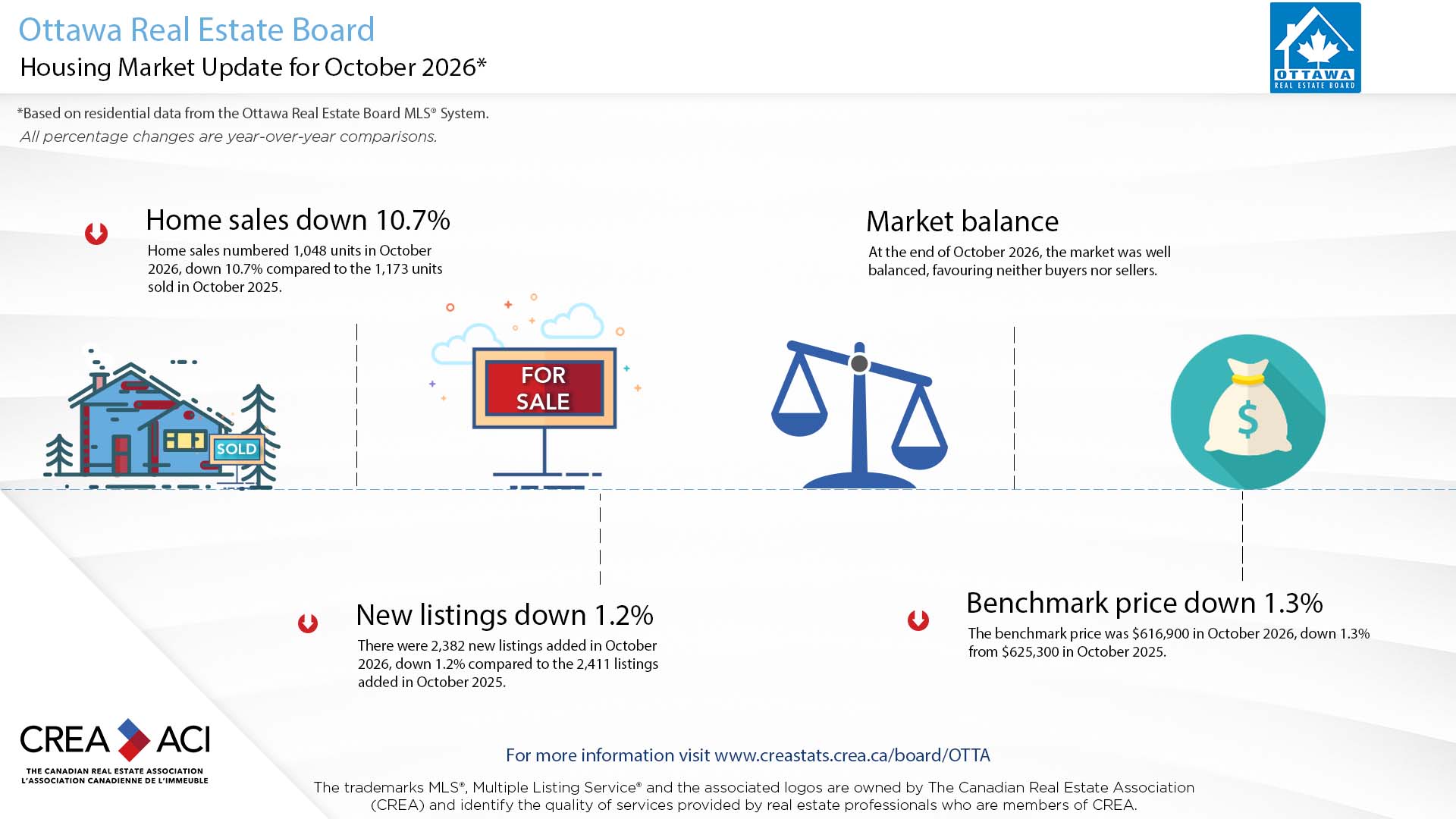
A total of 1,048 residential properties sold through the MLS® System in October, down 10.7% from 1,173 in October 2025. That's the third-lowest October sales total since 2016. The good news for sellers is the direction of travel: sales rose 3.8% from September, while new listings dropped 18.6% month over month to 2,382.
That combination pushed the sales-to-new-listings ratio up to 44.0% from 34.5% in September, and brought months of inventory down to 4.4 from 4.8. OREB's infographic describes the market as balanced, favouring neither buyers nor sellers. In practice, conditions still lean toward buyers compared with a year ago, when months of inventory sat at 3.7 and the sales-to-new-listings ratio was 48.7%.
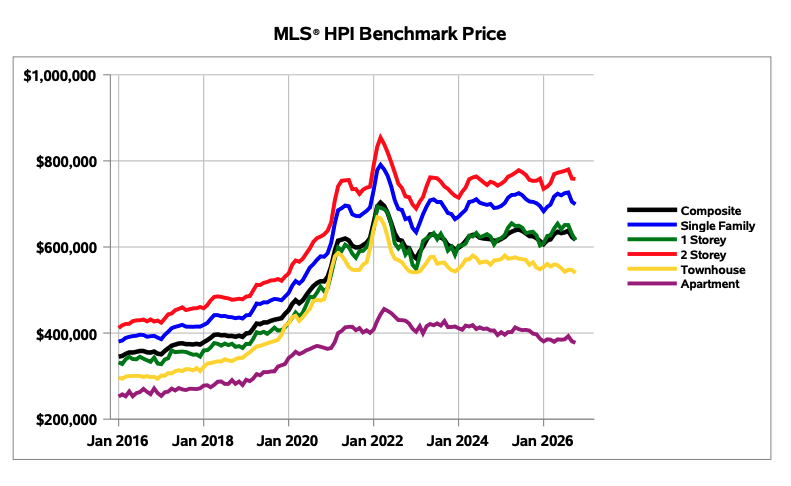
The MLS® Home Price Index (HPI) composite benchmark came in at $616,900, down 1.3% from October 2025 and 1.1% from September. The HPI tracks homes with consistent characteristics, so it's a better read on true price movement than the average, which shifts with the mix of homes that sell in a given month.
One encouraging detail: after seasonal adjustment, the index fell about 0.5% in October, compared with a 1.5% drop in September. Prices are still edging down, but the pace has slowed.
The average sale price was $678,512 (down 4.5% year over year) and the median was $622,000 (down 3.9%). Homes sold for an average of 97.5% of their list price, and the median home sold in 25.5 days, essentially in line with last October.
Benchmark Prices by Property Type
| Property Type | Benchmark Price | vs. Sept. 2026 | vs. Oct. 2025 |
|---|---|---|---|
| Composite (all types) | $616,900 | -1.1% | -1.3% |
| Single-family | $699,200 | -0.8% | -0.8% |
| One-storey (bungalow) | $615,700 | -2.3% | -3.1% |
| Two-storey | $758,100 | -0.1% | +0.6% |
| Townhouse | $539,800 | -1.2% | -4.3% |
| Apartment / condo | $377,500 | -0.9% | -5.3% |
Two-storey detached homes are the one segment holding value year over year. Condo apartments remain the weakest, a pattern we've seen all through 2026.
Sales were below last year across all three major property types:
- Single-family: 558 sales, down 12.5%. New listings were up 1.3% to 1,202, the second-highest October count since 2016. Months of inventory: 4.0.
- Townhouses: 350 sales, down just 3.0%. New listings rose 1.9% to 740, the highest October total since 2016. Months of inventory: 3.6, the tightest of the three.
- Apartments: 115 sales, down 23.3%. New listings fell 10.9% to 367. Months of inventory climbed to 7.4, up from 5.8 a year ago.
If you're selling a condo apartment in Ottawa right now, pricing and presentation matter more than they have in years. With more than seven months of supply, buyers can afford to wait for the right unit.
Ottawa's suburbs continued to carry the market, accounting for 753 sales, or 71.9% of all transactions. Sales were down year over year in all three suburban areas, but conditions there were noticeably firmer than downtown or in rural areas.
| Area | Months of Inventory | What It Means |
|---|---|---|
| Ottawa Suburb East | 3.5 | Tightest submarket in the city; 51.0% sales-to-new-listings ratio |
| Ottawa Suburb West | 3.7 | Steady, closer to balanced |
| Ottawa Suburb South | 4.1 | Balanced, with good choice for buyers |
| Ottawa Rural South / Rural West | 4.1 / 4.4 | Balanced, but small sample sizes (57 and 66 sales) |
| Ottawa Centre | 6.6 | Buyer-leaning, driven largely by condo supply |
| Ottawa Rural East | 7.3 | Buyer-leaning, and inventory rose from September |
The takeaway: "the Ottawa market" is really several markets. A townhouse in Orléans and a one-bedroom condo in Centretown are operating under very different conditions right now, so citywide averages only tell part of the story.
Through the first 10 months of 2026, 11,335 properties sold in Ottawa, down 7.3% from the same period in 2025, with total dollar volume of about $7.9 billion (down 8.0%). New listings reached 25,352, up 3.4%. The year-to-date average price is $695,598, down just 0.8%, and the median is $635,000, down 1.6%. In short, 2026 has been a year of more supply and fewer sales, with prices drifting lower rather than falling sharply.
If You're Buying
You have more homes to choose from than in any October since 2016, and on average homes are selling for about 97.5% of their list price. That gives you room to negotiate on price, conditions and closing dates, especially on condos and in Ottawa Centre. Just don't assume every listing is soft: well-priced freehold homes in the eastern and western suburbs are still moving at a healthy pace.
If You're Selling
October was a better month for sellers than September, but buyers are comparing your home against plenty of alternatives. Pricing off recent sales of similar homes in your specific neighbourhood, not last year's peak or the citywide average, is the single biggest factor in how quickly you'll sell. Homes that are priced right and show well are still selling in under a month.
Nobody can predict the market with certainty, but several forces will shape Ottawa housing over the next 12 months. Here's what we're watching.
1. Jobs and the Federal Public Service
Employment is the biggest question mark for Ottawa. An analysis by the Canadian Centre for Policy Alternatives, cited by OREB, found roughly 15,000 fewer people employed locally since March 2025, a larger loss than any other large Ontario municipality over that period. The federal government is planning to reduce the public service by about 16,000 full-time positions between April 2026 and March 2029, and roughly 43% of federal public servants work in the National Capital Region. OREB notes that earlier rounds of federal workforce reductions coincided with weaker sales and higher inventory in Ottawa.
2. Interest Rates
The Bank of Canada raised its policy rate to 2.5% on October 28, its first increase in three years, citing persistent inflation. That nudges borrowing costs up just as many buyers were starting to feel more confident. Whether this is a one-time move or the start of a tightening cycle will matter a lot for spring 2027 demand.
3. New Federal Housing Measures
The November 2026 federal budget included several measures that could affect Ottawa buyers and investors in 2027:
- A proposal to raise the price cap for insured mortgages from $1 million to $1.5 million, with 30-year amortizations limited to first-time buyers or newly built homes.
- Starting February 1, 2027, insured financing for triplexes and fourplexes, including construction loans of up to 90% of completed value and up to 30-year amortizations on completed properties, with no owner-occupancy requirement.
- An extension of the ban on foreign buyers of existing homes to January 1, 2029, with an exemption for new residential properties.
Several of these are still proposals, so details and timing could change. The multiplex financing changes in particular could open new doors for small investors and house-hackers in Ottawa's older inner-suburban neighbourhoods.
4. New Builds vs. Resale
New construction has been a bright spot. The Greater Ottawa Home Builders' Association (GOHBA) reported 521 new-home sales in September, up 81.5% year over year, and January-to-September new-home sales are up 53.8%. Expanded, limited-time HST relief for qualifying new homes is likely part of the reason. If that relief continues into 2027, resale sellers, especially of newer townhomes and condos, may keep competing with builders for the same buyers.
5. Economy and Rentals
According to the 2027 Emerging Trends in Real Estate report (PwC and the Urban Land Institute), Ottawa's real GDP is projected to rebound to 1.4% growth in 2027 after a weak 2026, with population edging up 0.2%. CMHC expects Ottawa's rental vacancy rate to rise to 3.8% in 2027, which means a looser rental market and more negotiating power for tenants. That's worth factoring in if you're buying a condo as an investment.
October 2026 gave Ottawa's market some welcome relief, with sales up from September, fewer new listings and price declines slowing. But conditions are still softer than last year, and they vary a lot by neighbourhood and property type. Whether you're planning to buy, sell or invest in 2027, our team can show you what's happening in your specific corner of Ottawa.
Sources:
Ottawa Real Estate Board, "Ottawa Home Sales Edge Higher in October as New Listings Ease" (November 5, 2026) and October 2026 Residential Market Activity and MLS® HPI Report (prepared by CREA). creastats.crea.ca/board/otta
Canadian Mortgage Trends, "Budget 2026 explained: 12 changes for housing, mortgages and banking"
CBC News, "Carney budget to slash public service by 16,000 over 3 years"
PwC & Urban Land Institute, "Emerging Trends in Real Estate 2027: Canada markets to watch"
Data is based on residential activity reported through the Ottawa Real Estate Board MLS® System. All percentage changes are year over year unless noted. The 2027 outlook reflects our team's opinion and is provided for general information only. It is not financial advice.