
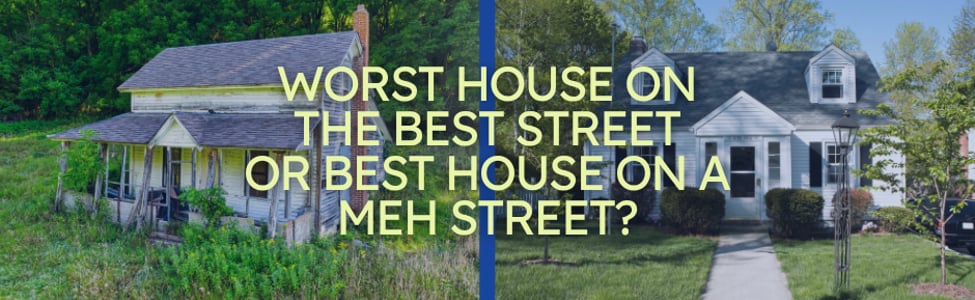
Few real estate debates are older, more opinionated, or more consistently unresolved than this one. Ask five experienced buyers and you'll get five different answers — usually delivered with the quiet confidence of someone who is absolutely certain they're right.
The conventional wisdom says: always buy the worst house on the best street. Location can't be renovated. Ride the neighbourhood up. The logic sounds airtight until you've actually looked at what it costs to bring a tired home up to standard, or spent a winter in a house that turned out to need far more work than you planned for.
The counter-argument has its own logic: buy a home you can actually live in comfortably, in a neighbourhood that works for your life, instead of betting on appreciation you might not see on the timeline you need.
Both sides have a real case. Here it is, laid out as honestly as possible.
First, What Are We Actually Comparing?
To keep this grounded: the "worst house on the best street" typically means a structurally sound but cosmetically dated or functionally limited home in a desirable, well-established neighbourhood — the one with the original kitchen while every neighbour has renovated, or the one with the smallest footprint on the block. It's not a teardown. It's a discount entry point into a premium location.
The "best house on a meh street" means a well-finished, move-in ready home in a neighbourhood that is perfectly liveable but lacks the cachet, the amenities, or the trajectory of its more sought-after counterparts. You get more house for your money. You may give up some of the location upside.
The choice between them is really a choice between two different theories of value — and two different answers to the question of what a home is actually for.
The Case for the Worst House on the Best Street
- You buy into a neighbourhood's ceiling, not its floor — surrounding homes set a natural price floor beneath you
- Location drives long-term appreciation more reliably than finishes or square footage
- You control the upgrades — renovate on your timeline, to your taste, at your pace
- Entry price is lower, which often means less mortgage, lower carrying costs, and more flexibility
- Proximity to schools, amenities, transit, and established community doesn't change when you renovate
- Neighbouring sales pull your value up over time regardless of what you do inside
The core of this argument is that you can change almost everything about a house, but you cannot change where it sits. A tired kitchen can be replaced in a weekend. The street it's on cannot. When the neighbourhood appreciates, every home on it appreciates — including the one that needed the most work when you bought it.
There's also a ceiling argument that works in your favour. In a strong neighbourhood, the surrounding sales set a natural floor that limits your downside. If comparable homes are selling for $950,000 and yours is the outlier at $750,000, there's a built-in margin that tends to protect you even in softer markets.
"You can renovate the house. You cannot renovate the neighbourhood."
The Case for the Best House on a Meh Street
- You actually live in your home — comfort and livability matter from day one, not after a two-year renovation
- Renovation costs are routinely underestimated, and the "cheap entry" can evaporate quickly
- The best house on the street faces an appreciation ceiling — surrounding sales limit how high you can go
- Lower price point often means a neighbourhood with more upside if it's improving
- A home that works for your life reduces stress, lifestyle compromise, and unexpected costs
- Not everyone has the capacity — financial or otherwise — to live through a major renovation
The part of this argument that gets underweighted is the renovation reality. Buyers who purchase the worst house on the best street with a plan to renovate often discover that the plan costs significantly more than projected, takes longer than expected, and requires living through a level of disruption they weren't fully prepared for. The "discount" entry can quietly become a wash once carrying costs and renovation expenses are factored in.
There's also the ceiling problem. The best house on a premium street does benefit from neighbourhood appreciation — but it's also capped by it. If your neighbours are all selling at $900,000 and you've invested in a home worth $1,100,000 in isolation, you will likely leave money on the table when you sell. The opposite problem from the worst house, but a real one.
And for buyers in neighbourhoods that are actually improving — not already at their peak — the best house on a street that's trending up can outperform the conventional wisdom entirely.
Where Each Strategy Tends to Win
| Factor | Worst house / best street | Best house / meh street |
|---|---|---|
| Long-term appreciation | Advantage | Depends on neighbourhood trajectory |
| Day-one livability | Varies — often compromised | Advantage |
| Downside protection in soft markets | Advantage | More exposure to price softness |
| Resale ceiling | Strong — pulled up by neighbours | Risk — capped by neighbours |
| Renovation budget required | Often significant and underestimated | Advantage — minimal or none |
| Entry price point | Advantage — lower in premium area | Lower overall, more house for money |
| School catchments / amenities | Advantage | Variable |
| Upside if neighbourhood improves | Limited — already priced in | Advantage — if chosen well |
| Lifestyle fit from day one | Depends on renovation timeline | Advantage |
The Questions That Actually Decide It
The honest answer is that neither strategy wins universally — the right choice depends almost entirely on your specific situation. These are the questions worth working through before you decide:
- 1 What is your real renovation capacity? Not what you hope to do — what you can actually afford, manage, and live through. If the answer is limited, the worst house on the best street can become an expensive trap rather than an opportunity.
- 2 How long are you planning to stay? The location argument gets stronger the longer your time horizon. For a 10-year hold, neighbourhood matters enormously. For three to five years, you may not have time to fully realize the appreciation upside.
- 3 Is the "meh" street actually improving? There's a significant difference between a neighbourhood that's been mediocre for twenty years and one that's quietly trending up. The latter can outperform the conventional wisdom. The former probably won't.
- 4 What does the price gap actually represent? If the worst house on the best street is $100,000 below comparable renovated homes in the same area, that gap needs to be honestly compared to the cost of the renovation — not just assumed to be free equity.
- 5 What do you actually need from your home right now? School catchments, proximity to work, space for a growing family — these practical realities sometimes make the decision for you, regardless of which strategy performs better in theory.
Whatever you choose, the fundamentals matter more than the strategy label. A genuinely bad home in a great neighbourhood is not a version of this debate — it's just a bad home. And a well-chosen home in a neighbourhood that fits your life will almost always outperform a theoretically superior choice that you're miserable in. The best house is the one that works for you, in a location you understand, at a price you can sustain.
Where Does Ottawa Fit Into This?
Ottawa's market adds a layer of nuance worth considering. The city's most established neighbourhoods — the Glebe, Westboro, Old Ottawa South, Rockcliffe — have track records of consistent appreciation that make the "worst house on the best street" argument genuinely compelling over a long hold. Entry price into those areas, even for a home that needs work, tends to be protected by the strength of surrounding sales.
At the same time, several of Ottawa's outer and transitional neighbourhoods have performed remarkably well over the past decade as the city has grown and infrastructure has improved. Buyers who chose the best house in those areas at the right moment captured appreciation that rivalled — and in some cases exceeded — what the premium neighbourhoods delivered.
Neither strategy has a monopoly on good outcomes in Ottawa. What matters is choosing deliberately, with eyes open to both the upside and the trade-offs of whichever path you take.
Not Sure Which Strategy Fits Your Situation?
We can help you think through the numbers honestly — what the renovation would actually cost, what the neighbourhood trajectory looks like, and which choice makes sense for where you are right now.
Talk to Our TeamCall us at (613) 704-5582 · [email protected]

